EndoTODAY 내시경 교실
Beginner | ESA | Schedule | OPD
Seminars | Atlas | Recent | Links
 [헬리코박터 제균 후 발생하는 위암. Gastric cancer after eradication (GCAE)] - 終
 1. Introduction
헬리코박터 제균치료 후 발견되는 위암(GCAE)은 제균치료 전부터 있었던 것인지, 새로 발생한 것인지 명확하지 않습니다. 현재는 제균치료 전부터 존재하였던 것으로 추정된다. 제균치료의 역사가 길어지면 이러한 상황은 바뀔 수 있습니다.
2. GCAE 내시경 소견
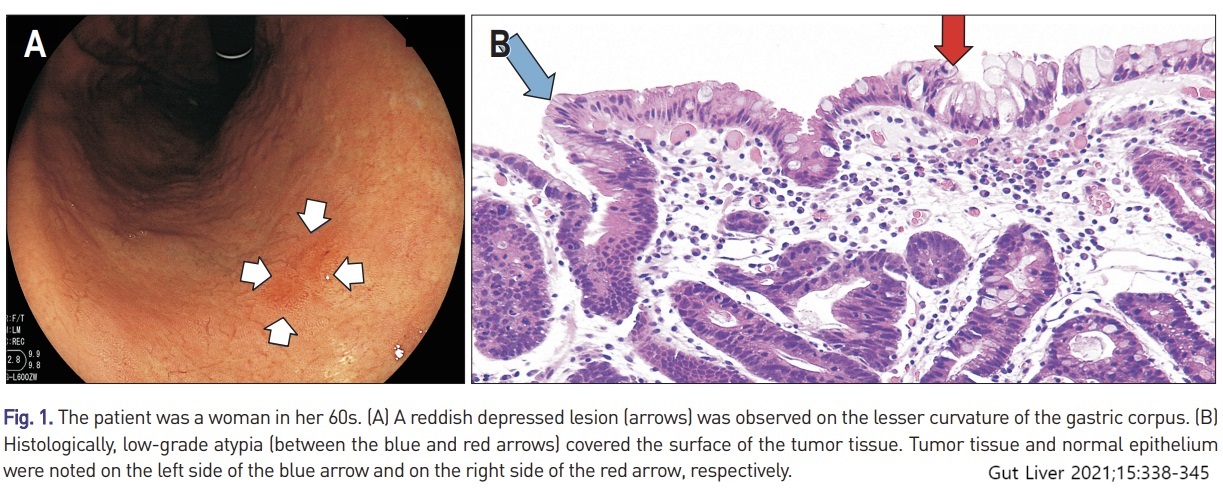
GACE의 대표적인 내시경 특징은 표재성 함몰형태를 보이는 비율이 높다는 점입니다(reddish depression (RD)). 제균치료 후 선종의 50%, 선암의 24%는 flat하거나 indistinct한 특성을 보였습니다 (Ito 2005). 그 이유는 serum gastrin으로 추정되는데, 헬리코박터 제균치료는 혈청 가스트린을 낮추어 위점막 가스트린 수용체를 통한 세포증식을 줄이기 때문이라고 합니다 (Ito 2008).
병히적인 소견으로 약간 변이된 상피조직이 위암을 덮고 있는데 epithelium with low grade atypia, ELA이라 부릅니다. ELA는 아래와 같이 정의됩니다 (Kitamura 2014).
상세한 유전학적 연구를 통하여 ELA는 암의 표면이 제균치료 후 회복(restore)된 것으로 분석된 바 있습니다.
[References]
1) Characteristics and Early Diagnosis of GCAE Gut Liver 2021
Differentiated cancer types were frequently found after eradication and included characteristic endoscopic features such as reddish depression (RD). However, benign RD can be difficult to distinguish from gastric cancer because of histological alterations in the surface structures (nonneoplastic epithelium or epithelium with low-grade atypia [ELA]) as well as multiple appearances of RD. Recently, we clarified similar alterations in genetic mutations between ELA and gastric cancer, suggesting that ELA is derived from gastric cancer. Clinically, submucosal invasive cancer was frequently found in patients after eradication therapy even if they received annual endoscopic surveillance.
© 일원내시경교실 바른내시경연구소 이준행. EndoTODAY Endoscopy Learning Center. Lee Jun Haeng.